Vector Addition, Subtraction, and Scalar Multiplication
Grade 6Adding vectors
To add two vectors, add their corresponding components.
Geometrically, placing vectors tip to tail gives the resultant — the single vector that has the same effect as both combined.
Scalar multiplication
Multiplying a vector by a scalar scales it. 2a is twice as long as a, in the same direction. −3a is three times as long, in the opposite direction. All components get multiplied by the scalar.
Worked example
Vector paths
In geometry problems you often need to express one vector in terms of others. The rule: travel along known vectors, reversing direction (and sign) when you go against the arrow. This is the key technique for all vector proof questions.

Try this one
Past paper - 2023
OABC is a parallelogram.
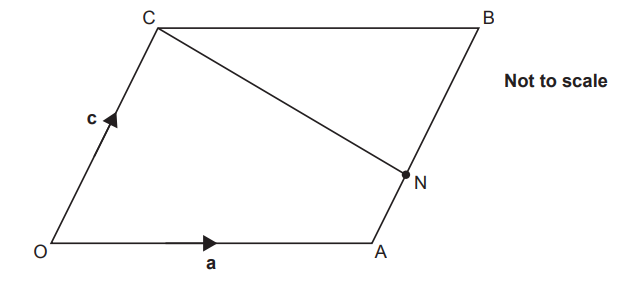
\(\overrightarrow{OA}=a\) and \(\overrightarrow{OC}=c\)
The point N lies on line AB such that AN: NB = 3: 5.
(a) Find the following vectors in terms of a and c. Give your answers in their simplest form.
(i) \(\overrightarrow{OB}\)=------------[1]
(ii) \(\overrightarrow{ON}=\)----------- [2]
(b) Line CN is extended to reach point P, such that \(\overrightarrow{CP}=\frac85\overrightarrow{CN}\)
Show, using vectors, that OAP is a straight line. [4]